

When a business decides marketing needs more attention, the first idea is often the most obvious one: hire someone. And because budgets are tight, that someone is usually junior. A bright graduate, a marketing assistant or an executive with a couple of years' experience.
On paper, it makes sense. Hiring a marketing assistant costs a fraction of a marketing manager's salary. They are enthusiastic, digitally confident and keen to learn. You get a person in the building whose whole job is marketing.
In practice, it often goes differently. Six months in, the website still has not been updated, the social media is busy but not producing enquiries, and the MD is spending more time managing marketing than before.
None of that is the junior hire's fault. It is the role they were given.
This article looks at what a junior marketing hire really costs, what you get for that money, and why an outsourced marketing team can deliver more for a similar or lower spend.
Why the junior hire looks like the safe choice
The logic behind a junior hire is easy to follow.
It feels affordable. A junior salary is far lower than a senior marketer's, and much lower than the combined cost of several specialists.
It feels controllable. The person sits in the office, reports to someone internally and can be given tasks day to day.
It feels like a step forward. Moving from no marketing person to one marketing person feels like progress, and it is visible progress.
For some businesses, it is the right call. But the decision usually rests on comparing a junior salary with an outsourced monthly fee, and that comparison leaves out most of what matters.
The problem: you are hiring a junior to do a senior job
Most growing businesses do not need someone to post on LinkedIn. They need someone to work out who they are selling to, what they should say, which channels are worth the money and how to turn interest into enquiries.
That is strategy. And strategy is the one thing a junior marketer is least equipped to provide.
Think about what a business with £2m to £10m turnover actually needs from its marketing:
A clear plan linked to sales targets
A website that explains what you do and generates enquiries
Content that shows expertise to the right buyers
Design that looks professional across every channel
Email, social media and campaigns that run consistently
Reporting that shows the board what is working
A junior hire might handle two or three of those well. They are unlikely to cover all of them, and they will rarely know which ones matter most for your business.
So the question is not whether a junior marketer is capable. It is whether you are asking one person, early in their career, to be your entire marketing department.
The hidden costs of a junior marketing hire
Salary is only the start. When you look at the full cost of employing a junior marketer, the gap between in-house and outsourced narrows quickly.
Employment costs
On top of salary there is employer National Insurance, pension contributions, holiday cover and any benefits. Recruitment adds more, whether through agency fees or the internal time spent advertising, shortlisting and interviewing.
Tools and software
A marketer cannot do much without tools. Design software, email platforms, social scheduling, SEO tools and analytics all carry subscription costs. An agency already pays for these and spreads them across clients.
Training
Junior marketers need training to grow, and the good ones will want it. Courses, conferences and certifications all cost money, and they still leave gaps that experience fills.
Management time
This is the cost most businesses forget. A junior marketer needs direction. Someone has to set priorities, review work, sign off content and answer questions. In most SMEs, that someone is the MD, a director or a partner.
If a director spends even a few hours a week managing marketing, that time has a real cost. It is time not spent on clients, sales or running the business.
The specialists you still pay for
Even with a junior in post, most businesses still buy in a web developer, a designer for bigger pieces, or help with SEO and paid advertising. So the junior hire does not replace outside spend. It often sits on top of it.
Add these together and a "cheap" hire can cost far more than the salary suggests, without giving you senior expertise.
What happens when it does not work
The real risk with a junior hire is not the cost. It is the time lost.
Typically, the first few months go on settling in and learning the business. The next few produce activity: posts, newsletters, perhaps a new brochure. But without a clear strategy behind it, that activity rarely moves the numbers.
By the end of the first year, the business has spent a full year's employment costs and is not much further on. The junior marketer may feel unsupported and move on, taking their knowledge, logins and momentum with them. Then the cycle starts again.
That lost year is the most expensive part. Competitors who invested in proper marketing during that time have moved ahead.
What an outsourced marketing team brings instead
An outsourced marketing team works differently. Rather than one person learning on the job, you get access to experienced people across several disciplines.
Senior thinking from day one
A good outsourced team starts with strategy: understanding your market, your competitors, your best clients and your sales targets. That plan shapes everything else, so activity has a purpose from the start.
A range of skills, not one
Strategy, copywriting, design, website updates, SEO, email and social media all sit within the same team. You get the right skill for each job rather than one person stretching to cover everything.
Less management, not more
An experienced team does not need to be told what to do. You agree goals and priorities, then they get on with it. A short weekly update and a monthly planning session is usually enough to keep everyone aligned.
Consistency
Outsourced marketing does not take holidays all at once, go off sick or resign without notice. Work continues, plans stay on track and nothing is lost when one person leaves.
Flexibility
When you need more support for a product launch, an exhibition or a new service, the team scales up. When things are quieter, it scales back. You are not locked into a fixed headcount.
Comparing the two properly
When you compare a junior hire with an outsourced team, compare what you get, not just what you pay.
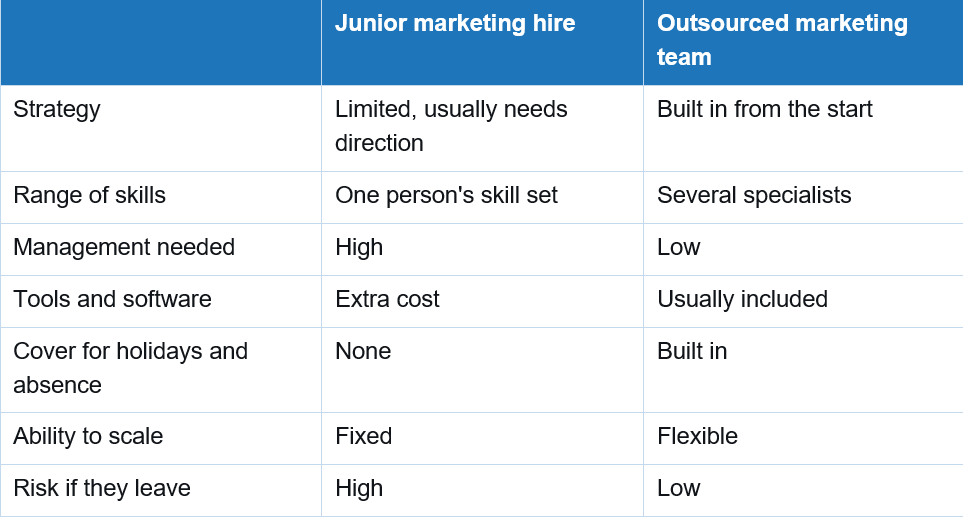
Once you look at capability rather than salary alone, the outsourced option often costs a similar amount or less, and delivers considerably more.
When a junior hire does make sense
This is not an argument against ever hiring junior marketers. There are situations where it works well.
If you already have a senior marketer who can direct them, a junior hire adds valuable capacity. If your marketing is mostly day-to-day coordination and the strategy is already clear, a junior can execute it well. And if you want someone in the building to capture stories, photos and updates, an internal person is useful.
In fact, one of the most effective setups combines both: a junior marketer internally who knows the business, supported by an outsourced team that provides strategy, specialist skills and direction. The junior grows faster, the work is better and the business gets the benefit of both.
Questions to ask before you hire
Before you advertise a junior marketing role, it is worth asking:
Do we have a clear marketing strategy for this person to deliver?
Who will manage them, and do they have the time and marketing knowledge to do it well?
Which specialist skills will we still need to buy in?
What will the full cost be once tools, training and management time are included?
What happens to our marketing if they leave in 12 months?
If the answers leave you unsure, an outsourced team may be the better first step.
The bottom line
A junior marketing hire looks like the cheaper option, and on salary alone it is. But marketing is not one job, and a business that needs to grow needs senior thinking as well as hands-on delivery.
Cheaper only counts as value if the work gets done and the results follow. For many businesses, an outsourced marketing team gives them more skills, more experience and more consistency for the same money, without the management burden or the risk of starting again.
Start the conversation with EWO
At EWO, we work as an outsourced marketing team for growing manufacturers and professional services firms. Strategy, content, design and digital are all handled in one place, so your marketing keeps moving without adding headcount. If you are weighing up a junior hire, let's talk through what would work best for your business.